Continuation of NeuraPRO Part 2
🛠️ NeuraPRO – Part 3
From Workana to Claude Code: Freelancers, Full Redesign, Parallel Agents, and How to Consolidate a System Before the MVP
“I thought the hardest part was building the system. It turned out the hardest part was building myself as a founder.”
When I closed Part 2 I had a solid backoffice, passing tests, and a working deploy. I felt like I had crossed an important milestone. What I didn’t know was that the next stage would be more chaotic, more human, and in many ways more valuable.
But there was a bigger problem.
Building something that works is relatively straightforward.
Building something that someone trusts enough to make decisions with… that’s a different story.
1️⃣ I Discovered Workana — and Learned to Let Go of Control
The scope kept growing. Every week something new appeared. There came a moment when I looked at the project and saw it clearly: I had the technical vision and the business logic, but I lacked the creative eye. Someone who could look at the interface without knowing the code behind it.
I found Workana. The model is simple: you post your project, receive proposals, and choose. What nobody tells you is that choosing well is an art learned through trial and error.
I’ve gone through good, average, and bad freelancers. The good ones understand the brief immediately and ask smart questions. The average ones need more feedback but they deliver. The bad ones simply disappear or hand in something completely unrelated to the request.
But even from the bad ones I learned: how to write better briefs, how to ask for previous examples, how not to hand over full access on day one.
I hired help for the landing page, for the visual redesign, for marketing images and videos. It’s not expensive — the prices are reasonable — but it does demand real management. What you gain in speed you invest in coordination. That’s a trade-off worth understanding before you dive in.
The most valuable logic of the platform is something else: gradually you build a circle of trust. Someone who did a task well gets priority for the next one. Over time that’s worth more than any individual feature.
Because it’s not just about building fast — it’s about building something someone can use without friction.
2️⃣ A Mentor Appeared — and Changed the Way I Work
In parallel with Workana, something more important happened: a friend with deep development expertise started guiding me.
He’s not someone who writes the code for me. He’s someone who looks at what I built and tells me what doesn’t work, why it doesn’t work, and how it should work. He gave me perspective on testing, on best practices, on how to structure work so it scales without breaking.
That kind of guidance no AI can replace. AI helps you execute. A mentor helps you think.
Today I work with that combination: human guidance sets the criteria, AI executes. It’s been an important gear shift.
That criteria is what later translates into decisions the user never sees… but that make the system work well.
3️⃣ The AI Tools Zoo — and What I Learned from Each One
This stage was also the one of the tool explosion. And here I have to be honest about what I experienced.
I started with Cursor. I dropped it for a while because the bill was getting out of hand. I switched to GitHub Copilot thinking it would be equivalent. It wasn’t.
Copilot has its virtues, but as the project grew it got tangled. Fine redesigns, modal details, visual consistency — Cursor handles them better. There’s something in how it understands the visual context of an interface that Copilot doesn’t quite match.
I went back to Cursor. Today I have both active, but with different roles: Cursor on Pro plan for the fine work, Copilot on Pro for support tasks.
I also learned how they charge: Copilot by premium requests, Cursor by tokens. Understanding that difference helps you use them more intelligently and more cheaply.
And recently I discovered Claude Code. Powerful. Very powerful. Also with its cost.
The final result: I have GPT, Copilot, Cursor, and Claude on paid plans. At some point you have to laugh at yourself and accept it — there’s no going back. NeuraPRO has to fly.
4️⃣ The Agent Chaos — and Why Context Has a Human Limit
There were periods where I had 8 or 10 agents working in parallel across different repos. Some on small tasks, others on larger changes.
It looked productive. And sometimes it was.
But I learned that the number of parallel agents has a practical ceiling. When I’m working on something important I try not to exceed 3 active simultaneously. Context fragments, changes start to collide, and coordination consumes more energy than the progress itself.
The real problem isn’t technical — it’s human. I’m the one who has to keep the thread between all of them. And that thread has a maximum width.
5️⃣ The Redesign Nobody Asks for Until They See It
With all that context came a difficult decision: redesign the entire app.
It was painful. It was necessary.
Every view looked different. Buttons weren’t consistent between pages. Modals had different formats. It was coherent in logic but chaotic in form.
I standardized everything under a v2 system: headers, KPIs, filters, tables, buttons, colors, and modals now follow a single contract. Change something in one place, it reflects everywhere. I removed redirects to new pages for forms — now modals open on the same screen, modern SaaS style. I added costs as a central data point, fundamental to understanding the real health of the business.
The result is an app that looks professional. That gives confidence to anyone seeing it for the first time.
Because in the end, it’s not just about the system working. It’s about someone looking at it and thinking:
“ok, I can trust this”
A lesson that came at a cost: I hired testing help before the redesign. That work became obsolete when I changed everything. I accept it. Rome wasn’t built in a day, and I carry this experience as a lesson for the next project — not as a mistake to repeat.
📸 NeuraPRO v2 — the redesign in action
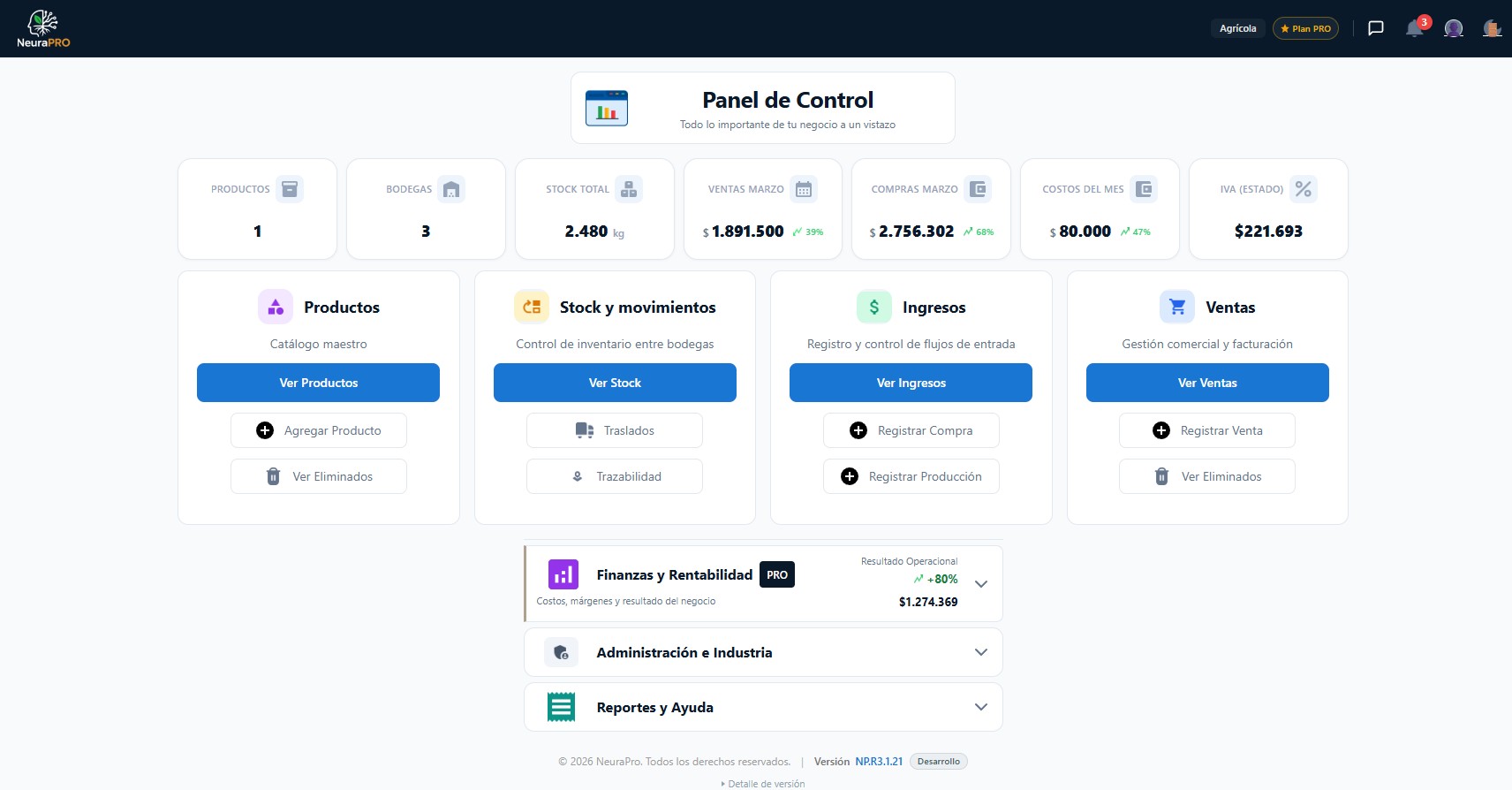
Control panel: centralized navigation and access to the v2 system

Inventory view: v2 system with unified headers, KPIs, and tables under a single visual contract

Balance view: costs as a central data point, visual consistency across every module
6️⃣ The NeuraPRO Portal and Operational Visibility
As the system matured, a need appeared that I hadn’t anticipated: how do clients access it in a clean and secure way?
I built the NeuraPRO Portal: an independent frontend for tenant registration and provisioning. Once authenticated, an integrated SSO takes them directly to their space in the app — no extra friction.
In parallel I built admin panels for both systems: real-time visibility of backups, tenants, errors, deploy status, and client management. Before, I was operating blind. Now I’m not.
I also built automated deploy scripts. With a single command, changes go up, services restart, and the system verifies itself. I have separate preprod and prod environments, synced with Git.
This isn’t just convenience. It’s what allows the system to be usable day to day without friction.
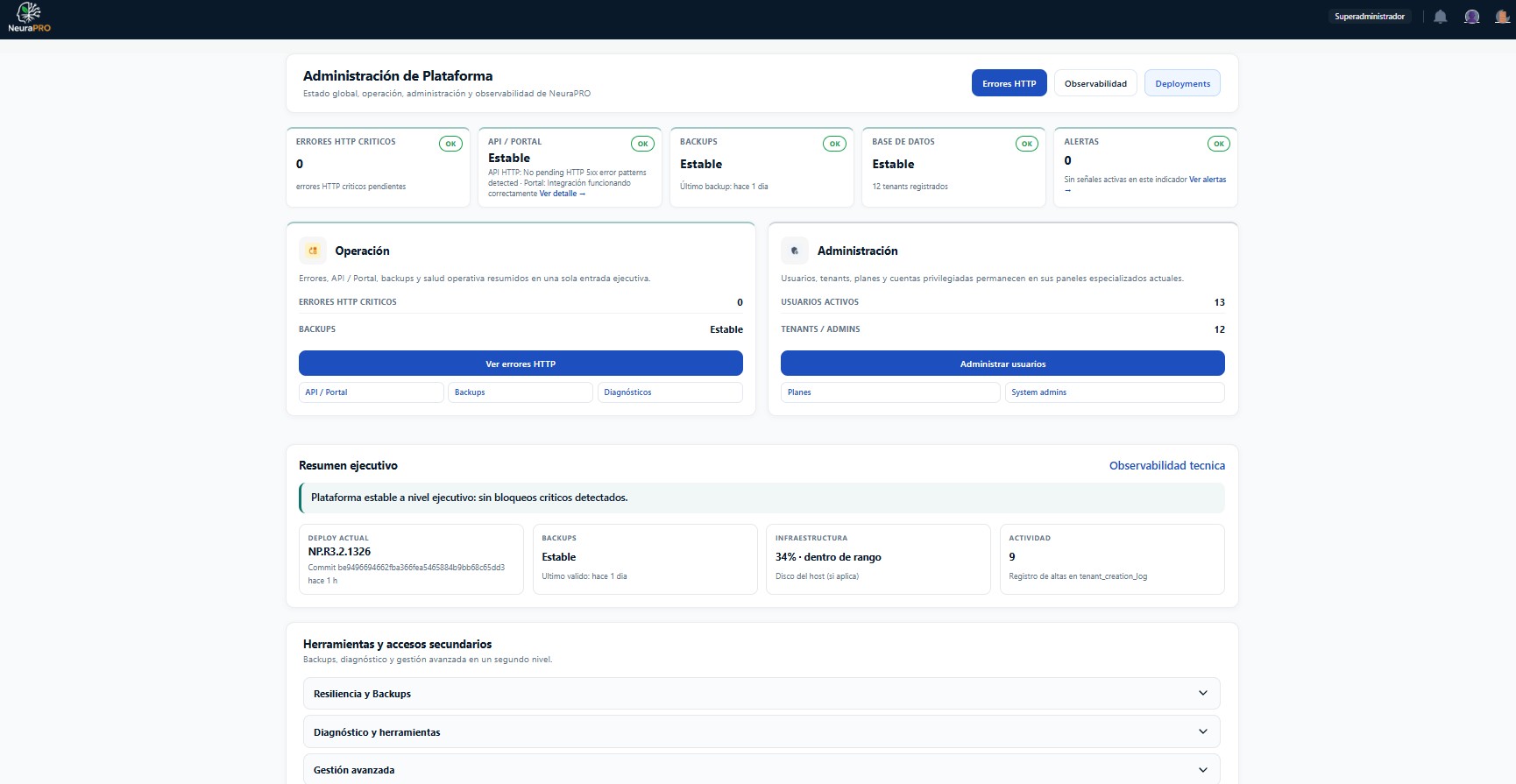
Admin panel: real-time visibility of backups, tenants, errors, and deploy status
7️⃣ Freeze to Consolidate
There came a moment when I had to make a decision that goes against any founder’s instinct: stop adding features.
I froze backend feature development. The focus now is the test suite — well organized, well covered — so that when the time comes to introduce changes, the system warns if something breaks before it reaches production.
At that point, the system already did a lot of things. But doing a lot of things is not the same as doing them well when it matters.
It’s a less visible stage than building new features. But it’s the one that determines whether the system holds when there are real users.
What I did leave ready is promising: the system is ready to call an LLM — OpenAI, Claude, or any other — with prompts built from real NeuraPRO financial data. Seeing how a model responds with real business data is going to be an interesting moment. That’s coming.
If I look at all of this in perspective, there’s a clear pattern:
every decision — even when it looks purely technical — ends up impacting the same thing:
how trustworthy the system is when someone actually uses it.
Final Reflection
This stage was more chaotic than the previous ones — and more real.
Letting go of control, asking for help, and accepting difficult decisions isn’t comfortable. But it’s what allows the system to stop being a project… and start being a product.
Today NeuraPRO isn’t just something that works.
It’s something that’s starting to be trustworthy.
And that changes everything.
Because in the end, it’s not about having more features.
It’s about being able to make decisions knowing the numbers make sense.
And that’s the point where NeuraPRO starts to stop being an idea… and gets closer to being a real business.
✍️ Claudio from ViaMind
“Dare to imagine, create, and transform.”
🔗 Connect with the Story
- 🔙 Part 2: NeuraPRO Part 2 — From Idea to a System That Breathes Alone
- 🔜 Part 4: Coming soon — The MVP
FEATURED POSTS
ABOUT ME

ViaMind Ecosystem
- ViaMind — The brand hub for ideas, technology and strategy.
- NeuraPRO — Practical software for managing real operations.
- ViaMind Radar — Less noise, more signal. AI-curated technology stories.